Saturday, August 29, 2009

"Perry Rhodan: Peacelord of the Universe!"


I have to say that one of the things that I really like about doing this blog is the way that it leads me in different directions. Right now I'm in the middle of researching material for three posts dealing with the Dune series, and I'm working on a photocomp image for one of those blog-posts-about-blogging that pop up now and then. Nonetheless, I'm going to drop everything and talk about Perry Rhodan.

Now, I freely admit this is my own fault for setting this up in the previous post with the joke about Rhodan versus Rodan, but I'm surprised that the person who broached the question wasn't one of my (six) regular readers. I'd like to extend my thanks to Zach, down in Utah, for following through:
Very well - who is Perry Rhodan?

The Perry Rhodan series is the brainchild of two German authors, Karl Scheer and Walter Ernsting. The series, which started in Germany in 1961, drew heavily on early science fiction for inspiration, and is written by a rotating stable of authors - possibly by necessity, since there are apparently more than 2500 episodes in the series. I refer to them as "episodes" because the Perry Rhodan stories were originally produced in a weekly serialized format that's more like chapters in a story than stand-alone novels.

The books first appeared in English translation in 1969, but as far as I know only a few hundred of the episodes have been published in English.

I hadn't read a Perry Rhodan book for about thirty years, and my schedule is open until I start my new job next week. So, in the interests of research, I hunted around on the internet and found a downloadable copy of the first book, Enterprise Stardust, and picked up a few of the later paperbacks at Pulp Fiction, my local used bookstore.

Enterprise Stardust: the stage is set with the departure of a four man mission to the Moon, led by Major Perry Rhodan, in 1971. (Interestingly, in spite of the German authorship, it's an American mission.) However, as the expedition prepares to land, unexpected electronic interference causes the ship to go out of control, and it makes a near crash-landing on the surface of the Moon. In the course of investigating the accident, Rhodan and his crew discover that a derelict alien spaceship is responsible.

The massive globular craft is part of the Arkon Imperium, a once mighty intergalactic empire which has fallen into a state of decay and decadence - in fact, only two of the crew are even able to summon up the interest to speak to Rhodan, and one of them is dying from their equivalent of leukemia. However, the dying man sees in Rhodan - and perhaps in humanity as a whole - the dynamic energy once possessed by his race, and convinces the captain of the ship to equip Rhodan with their more advanced technology in the guise of payment for an attempt to cure the sickness.

Thus equipped, Rhodan and his crew return to Earth, but not to America. Instead, they land in the Gobi Desert, and begin planning to use the science of the Arkonides to unite the world and conquer the universe.

After this humble beginning, no science fiction stone is left unturned as the series develops - alien races, intergalactic warfare, world government, mutant powers, immortality, fifth dimensional space drives, time travel, mind parasites, parallel dimensions, and an entire range of technological gimmicks, wonders and inventions.

When I started reading, I was amazed at how quickly it all came back to me: Perry's friend and second in command Reginald Bell, frequent provider of comic relief; the exotically beautiful alien commander Thora, who was also Perry's reluctant love interest; Khrest, the agèd "Arkonide Mastermind"; the Mutant Corps - hey, what ever happened to the mutant Ernst Ellert, who became lost in time at some point?* - and Perry's base in the Gobi Desert, protected by the impenetrable barrier of the Radiant Dome (Episode 3). And, of course, Perry himself, a steely-eyed visionary who sees it as his duty to unite humanity and travel to the stars.

To be honest, I consider Perry Rhodan books to be the science fiction equivalent of potato chips. They're short little books, and provided that they're not the only thing in your diet, they make kind of a fun snack. The writing suffers horribly in translation, I suspect - I had this ongoing desire to edit the text when I was reading the digital copy. That aside, I was surprised by how much I enjoyed reading them.

Although the books don't seem to be as well-known in North America as they were when I was in high school, the international Perry Rhodan fan base may still give Star Trek and Harry Potter a run for their money. In fact, the Perry Rhodan fan phenomenon may have set the stage for Star Wars fandom, since both require a certain acceptance of any possible shortcomings of the material.

And like Star Wars, the Perry Rhodan universe is painted with a large brush, as the saying goes, but let's be fair: it's painted on a canvas of intergalactic proportions. Wouldn't you want a big brush for that?
- Sid

* Ha, it looks like he got back in issue 83 - just a happy coincidence that I found that particular cover for the opening lineup.

Thursday, August 20, 2009

But they're experts on Tintin.


>> By the way, do you know who Mothra is? <<
You mean the giant moth or is there another one I should be aware of?

Colin Campbell (very nearly half of the Campbell Brothers)
The poll is over, and the results indicate that only members of Laurie's family are unaware of Mothra. However, hardly anyone knows about Ghidrah, the three-headed dragon, and only three of us have to worry about getting Rodan (the giant pteranodon) mixed up with Perry Rhodan.
- Sid


(Okay, I admit it, I only did this post because I found a really great quality Mothra poster JPEG online and couldn't bear not to use it for something. Now to sit back and wait for questions about Perry Rhodan...)

Sunday, August 16, 2009

Understanding Comics


To kill a man between panels is to condemn him to a thousand deaths.
Scott McCloud, Understanding Comics
Just back from breakfast, where my friend Laurie returned my copy of Sin City - the collected comics, that is - which I'd lent to her so that she could see what they were aiming for in the production of the film version. I asked what she thought of the two in relative terms, and she said that she found the movie easier to follow, because it didn't have the fragmented jumps from frame to frame that the comic had.

It's an interesting criticism of the space-bound nature of comics versus the time-bound approach of movies. Movies are designed to flow through time: they start, run for a specific period of time as determined by the director, and take place in one location: the screen. Comics are the opposite - the story's physical existence is spread out in space, with multiple moments in time existing simultaneously on each page and sometimes in a single panel.

For a much more comprehensive discussion of the nature of comics, I unhesitatingly recommend Scott McCloud's Understanding Comics, a clever and thoughtful examination of how and why the medium of comics works.

Understanding Comics is one of those rare books which fully deserves the title "instant classic". Since its publication in 1993, it has become the standard for any discussion regarding comics. Not everyone agrees with its conclusions, but it's impossible to ignore the quality of the consideration which McCloud has given to the topic - presented, of course, in the form of a large comic book.

McCloud, acting as his own black-and-white narrator, offers a complete view of the comic: he defines it, views its historical roots, examines how our minds process the content, looks at the mechanics of the frame and transition between frames, abstraction and realism in style, and the flow of time, and concludes with a comprehensive personal theory on the nature of the creative process in general. But this quick summary does the book an injustice: there is not a single page which does not present the reader with some new or unexpected insight.

For me as a long-time reader of comics, Understanding Comics offers an amazing education in the nature of the medium, but I'm honestly not sure how it would read to a non-fan. I suppose I could lend it to Laurie and get her opinion - although, come to think of it, she'd probably prefer the movie version.
- Sid

Sunday, August 9, 2009

Geeks, nerds, anoraks, otaku, boffins, poindexters, etc.


X-Men comics, you know I collect ‘em
The pens in my pocket, I must protect ‘em

My ergonomic keyboard never leaves me bored
Shopping online for deals on some writable media
I edit Wikipedia
I memorized Holy Grail really well
I can recite it right now and have you ROTFLOL

Weird Al Yankovic, White and Nerdy
I just received a question via e-mail regarding the content of an earlier posting - specifically, "Who is Mothra?" I responded with a brief bio for the giant 60's Japanese moth-goddess who co-starred with Godzilla as well as appearing in some solo projects, and added a polite request that in future, questions about blog content be asked on the blog. (Just because I like having comments here, it gives the illusion of readership.)

The response to my request was as follows:
I didn't ask about Mothra on your blog because I didn't want to appear totally ignorant and stupid :-)
Sigh...okay, if anyone, ANYONE, reading this thinks that they've understood EVERY SINGLE OBSCURE SCIENCE FICTION FANTASY STAR TREK MONSTER MOVIE DOCTOR WHO COMIC BOOK ZOMBIE TIME TRAVEL PULP MAGAZINE SPACE EXPLORATION VAMPIRE STAR WARS GEEK REFERENCE that I've used on this blog? I strongly recommend that you turn off your computer right now and go out for a walk, get some fresh air, and PUT SOME TIME TOWARD GETTING A LIFE. My god, it's bad enough that I know all of this nonsense, heaven forbid that anyone else should be expected to.

And if you do have any questions? Open up a Comment and ask away.
- Sid

Tuesday, August 4, 2009

Cognitive Dissonance, or WTF?


Okay, you've got me on this one. It's definitely Patrick Stewart, and it's definitely the Enterprise. If anyone finds any sort of explanation of this, please do let me know what the hell was going on.

- Sid

Sunday, August 2, 2009

No, the giant goose at Wawa doesn't count.

During one of my early drafts for my posting on Canada in science fiction and fantasy, I was hunting around for suitable images with which to illustrate the article. To my intense disappointment, I couldn't find a single image that showed a real science fiction view of anything Canadian.

Undaunted, I decided to take another direction on the search - how about monster movies? Sorry, no luck. Godzilla has never breathed radioactive fire on Vancouver, King Kong never made it this far north, the Cloverfield monster was restricted to New York - I finally had to photocomp my own picture, as above (and ended up not using it anyway). I know that we have a reputation as a peaceful country, but damn it, has not one other person ever wondered what it would look like if Mothra decided to attack Sudbury?

To add insult to injury, it turns out that the Japanese aren't content to have had every giant lizard, insect, primate and robot on the planet visit Tokyo. No, that's not enough - in honour of the 30th anniversary of the Mobile Suit Gundam cartoon series, they decided to build a 1:1 scale model of the star of the show. The 60-foot robot now towers over onlookers in the Odaiba Shiokaze park. The head turns, and the eyes light up, but unfortunately that's as mobile as the statue gets.


To be honest, I have to think that there must have been something more important than giant combat mecha on the list of civic projects for Tokyo. But you've got to think that if it had been built earlier, it would have made those Independence Day aliens think twice before blowing up the Imperial Palace.

- Sid

Monday, July 20, 2009

"Houston, Tranquility Base here. The Eagle has landed."

At the time, I didn't really care about the Apollo 11 moon landing.

In my defense, it was 40 years ago, and I was seven. As a result, the real significance of the event was lost on me, but I do remember sitting on the floor in the living room and watching the coverage of the landing - it must have been on CBC, we didn't get any American channels. I feel a bit sad now that my recollection of the events isn't clearer. After all, from the perspective of 2009, the moon landing may well be the most significant historical moment of the 20th Century. In the immortal words of Neil Armstrong: "One small step for a man, one giant leap for mankind."

Or was it?

It's difficult to say if the moon landing or the first manned orbital mission should hold precedence here, but I'm going to stick with the moon landing. After all, "space" is a relative concept, and it's difficult to say exactly where it begins, whereas landing on the moon has a nice, definitive feel. That being the case, by the standards of the science fiction community landing on the moon should have been just the first step, rather than a giant leap.
It's not hard to run an alternate reality scenario here. Let's say JFK doesn't get assassinated, and in his next couple of terms manages to promote the exploration of the Moon as a crucial element of the fight against Communism. The Apollo missions following 11 aren't just imitations of the first landing, but instead begin to enlarge the American presence (given the photo I used to start this posting, I hesitate to say "footprint"). Four missions later and there's a permanent base - small, but it's there. By now there would be a constantly changing population of several hundred on the Moon, and there could easily be a manned mission in orbit around Mars, preparing to launch the Ares Lander.

Now obviously, that's not what happened, and it's somewhat tragic that the initial success of the lunar missions has gone to waste. Would a different president in the early 70's have changed anything? It's impossible to say, but it does raise the question of what a different president will mean now.

I suspect that Obama will ignore the exploration of space in favour of addressing a myriad of more pressing domestic problems - charity beginning at home, as it were. Admittedly, there's talk that the American space program may once again look at the Moon as a precursor to a landing on Mars. There's talk of a permanent base on the Moon, but there's also talk that a Moon base is irrelevant - if it's possible to build a base on the Moon, why not go directly to Mars, or possibly Deimos or Phobos? Sadly, I suspect that all this talk is just that: talk.

There are two sides to the whole discussion of space exploration. On one hand, it doesn't really matter. I won't argue the various benefits and developments that have resulted from the space program, because the man on the street probably just doesn't care. I suspect that it wouldn't take a lot of public opinion to tip the balance so that the United States government just folded up NASA and shuffled the money into health care, something with an observable benefit.

On the other hand, wouldn't a revived space program be a better national focus for the United States than the battle against terrorism? (And yes, it pretty much has to be the United States, I don't see anyone else being in a position to undertake the project.) I'm not going to suggest that they can ignore the terrorism issue, but the last eight years have made substantial changes in the mindset of the USA, and not for the better. A renewed space program might give the country a sense of pride and accomplishment that's been sadly absent for quite some time.

In the final analysis, or, as per my oft-used reference from the three-armed aliens in The Mote In God's Eye, on the gripping hand, all we can do is wait and see...
- Sid

Monday, July 6, 2009

The True North.


"So what do you trust?" Laughter in her eyes and utterly desirable.
He thought for a long time. "The cold," he said.
And watched her smile gutter like a candle and go out.

Sean Stewart, The Night Watch


"Can you tell me when to stop us there?"
"Can Gordon Lightfoot sing shipwreck songs?"
Who the hell is Gordon Lightfoot? Somebody with a shuttle named after him, whoever he is –
Elizabeth Bear, Scardown
When I decided to do a post dealing with how Canada is portrayed in science fiction and fantasy, I thought it would be a fairly straightforward process. However, as I started digging around in my library and doing some reading, it turned out to be a bit more complicated than just a question of geography.

As I've discussed previously, properly setting the scene is the great challenge for the science fiction or fantasy author, and obviously requires a greater degree of imagination than is necessary for mainstream material. However, it shares with the mainstream the problem of authenticity, of building a believable setting for the story.

So, Canada. What's required to set a story in Canada? I think that there's a very crucial difference between Canada and the rest of the world. Canada is a thin veneer along the edge of a huge wilderness - the majority of the population lives within about a hundred miles of the southern border. Mathematically we have one of the lowest population densities in the world, and I have no doubt whatsoever that there are many places in Canada that have never felt the touch of a human foot.

It is not unknown for people to go for a short walk into the woods and never come back. Fall through the ice in winter, and you're dead in minutes. Historical propaganda for the United States often refers to "taming the wilderness". I don't think anyone in Canada ever claimed to have tamed our country - at best we have managed to carve out a few niches at the edge of a vast silence.

How could any novel set in Canada not somehow address all of this?

Let's start with a bad example: Svaha, by Charles de Lint. This near-future post-apocalyptic story takes place for the most part in or near the Trenton Megaplex, part of the middle section of the Toronto-Quebec Corridor. Portions of this massive metropolitan sprawl have fallen into decay, and the remaining sections exist in a state of quarantine, with access being rigorously monitored in order to keep the street rats and mutants from gaining entrance.

In sharp contrast to this urban nightmare are the pristine Enclaves set up by the First Nations tribes. Gahzee, the protagonist, is a scout sent out from the Anishnabeg/Huron Enclave in the Kawarthas.

Unfortunately, there's not one thing in the entire book that makes the setting Canadian other than the place names. It's not that it's badly written, but there was never any point in the story where I felt that I was in Canada - the whole thing could be moved to the Boston-New York Arcology or the San Francisco-Los Angeles Urb without changing a single element.

The other side of the coin would have to be Sean Stewart's The Night Watch. Stewart has written a number of stories set in a sort of post-magical world, a world where a wave of supernatural phenomena has all but destroyed civilization. Godlike Powers control large or small territories, and monsters stalk the streets.

The Night Watch deals with two groups, the fortified remnants of Vancouver's Chinatown and the mercenary kingdom of Edmonton: the one surrounded by forest, the other by snow. In Vancouver, the forest has become the Forest: a dark, tangled, inimical entity sweeping across the greater part of the city, a Power that twists paths and kills unwelcome trespassers. On the other side of the Rockies, the North Side of Edmonton* is a realm of perpetual cold and frost held at bay by a fragile bargain based on the sacrifice of children.

In sharp contrast to Svaha, Stewart's settings invoke the basic elements of forest and cold that I discussed as characteristic of Canada: soldiers walk into the Forest and don't come out, and the description of one character's death by freezing is far too evocative. Stewart so accurately captures the two faces of Western Canadian wilderness, the darkness and rain of the coastal forests and the knifelike cold of the Prairies, that I can't imagine any way to move the story to another setting.

Honourable mentions in the Canada-as-setting category go to Wayland Drew's The Wabeno Feast and Elizabeth Bear's Jenny Casey trilogy: Hammered, Scardown and Worldwired. Much of the action of The Wabeno Feast takes place in Northern Ontario, against a backdrop of still lakes and silent forests. The description in the first chapter of the drive from Toronto to Lake Superior is beautifully accurate, and it's interesting to think of Canada's population slowly retreating into the woods in the wake of some sort of slow global catastrophe. To be honest, it's only marginally a science fiction novel, due to the apocalyptic element, but I felt that I should include it for its portrayal of the Eastern Canadian wilderness.

In contrast, there's no doubt that Elizabeth Bear's trilogy is science fiction: bionic enhancements, AIs, space ships, alien visitors, the whole catalogue. In Bear's future, global warming and other problems have destroyed the United States as a nation, and the failure of the Gulf Stream has frozen England and changed the face of Europe, but Canada has been relatively untouched. As a result, our traditional role as peacekeepers has become far more proactive, and Canada and China share an uneasy position as the dominant political forces on the planet.

I have to admit that there's nothing in the series that relates to the elemental features of Canada that Sean Stewart deals with, but I have to give Elizabeth Bear full points on Canadian culture. Naming the spaceships Calgary and Montreal is one thing, but naming the shuttlecraft after Canadian musicians is a clever touch. Some of the main characters are Quebecois and sometimes slip into joual, and there's a very familiar feeling to people going for coffee on Bloor Street and so on. There's room for nitpicking - I'm pretty sure that you can't turn west onto Bloor when you're northbound on Yonge, but when you get down to that kind of detail the author has obviously observed due diligence elsewhere.

And who knows, maybe they've changed the traffic laws in 2062 - it's science fiction, after all.

- Sid

* Now, personally, I would have picked Winnipeg for the home of Winter, but I can see how the author's desire to have the two areas relatively close together made him pick Edmonton instead.

Wednesday, July 1, 2009

The first nation of hockey - and the best part of North America.


Hey...

I'm not a lumberjack, or a fur trader....
I don't live in an igloo or eat blubber, or own a dogsled....
and I don't know Jimmy, Sally or Suzy from Canada,
although I'm certain they're really really nice.

I have a Prime Minister, not a president.
I speak English and French, not American.
And I pronounce it 'about', not 'a boot'.
I can proudly sew my country's flag on my backpack.
I believe in peace keeping, not policing,
diversity, not assimilation,
and that the beaver is a truly proud and noble animal.
A toque is a hat, a chesterfield is a couch,
and it is pronounced 'zed' not 'zee', 'zed'!!!!

Canada is the second largest landmass!
The first nation of hockey!
and the best part of North America

My name is Joe!!
And I am Canadian!!!
In a rare display of the herd instinct earlier today, I decided to wander down to Granville Island and see how Canada Day was playing out. A fragmentary little parade was winding its boisterous way through the narrow, packed streets, and Canadian flags were everywhere - t-shirts, hats, face paintings, and actual flags themselves. It was crowded, but convivial; disorganized, but friendly; all in all, the best possible picture of a nation happily celebrating its identity.

Canada Day is a very different event than the American equivalent that follows three days later. There's no militaristic element to our birthday: given the calm nature of our national reputation, it's not surprising that we legislated our way to independence, rather than fighting a war. And yet, commanding officers in both world wars commented on the unbridled ferocity with which Canadian soldiers fought - apparently when the circumstances call for it, we are more than able to make a stand.

Nonetheless, as in the famous "I AM CANADIAN" rant cited above, we believe in peace keeping, not policing, and as a result there aren't a lot of places where angry people burn the Canadian flag in protest of our actions.* (Which explains the rumour that American tourists may decide to have the ol' Maple Leaf sewed onto their backpacks instead of the Stars and Stripes.)

So, fine - what does all of this have to do with science fiction and fantasy?

My first thought was that in honour of Canada Day, I should take a look at Canadian science fiction. But you know, it gets fuzzy. Canadian author Tanya Huff was born and raised here, and continues to live in the country, but her university friend and fellow SF author S. M. Stirling relocated to New Mexico. William Gibson, originator of the cyberpunk movement, can be seen on the streets of Vancouver**, but he's originally from Texas, and Nova Scotian Spider Robinson moved to nearby Bowen Island in 2002, but grew up in the Bronx.

Even if we simplify life and decide that a Canadian author is an author who lives in Canada, it's difficult for me to identify a distinctive Canadian style for the sake of discussion. As unique voices, there are certainly lots of noteworthy Canadian authors, but I can't identify a group feeling to it, no kind of Maple Leaf Mafia. I've read opinions online that say that Canadian SF tends to examine how people exist within the future, rather than forming that future themselves, but I'm going to have to do a lot more research before I'm willing to make that judgement. And what about fantasy? Does the same comment apply in some fashion? I'm not certain that the two genres can be compared head-to-head in that way.

Okay, then....how about we look at Canada IN science fiction and fantasy? There, done - so after much preliminary debate, the next posting will compare "what if" and "once upon a time" views of the Great White North.

- Sid

* I'd like to say nowhere, but I recommend that you read Carol Off's The Lion, The Fox & The Eagle for an analysis of the mixed results of Canadian involvement in peacekeeping.

** And it's very exciting when it happens. Not long after I moved to Vancouver, I saw Mr. Gibson clumsily eating a bun as he strolled along Broadway near MacDonald - I felt all girlish for a moment, but refrained from embarrassing myself by falling at his feet à la Wayne's World and chanting "We're not worthy!!!".

Wider perspectives - or not.


As already established, I've been reading science fiction for what has effectively been my entire life. And, as a result, I think that I have an enhanced inner life, a broader imagination.

After all, I've seen Mankind skip through time like a child crossing a stream from rock to rock. I've watched post-human societies grapple with profound philosophical crises, and I've witnessed the death of the universe we know, and the start of universes unknown to us. Time itself has ended in front of my eyes, planets have been moved like pieces on a chessboard, galaxy-spanning wars for survival have been fought, and won, and lost.

And yet, and yet...half the goddamn science fiction movies that get made seem to involve nothing more thought-provoking than seemingly endless variations on hungry alien monstrosities dripping KY jelly. Sigh...

- Sid

Monday, June 29, 2009

"Just then, a horde of Nazi frogmen burst into the room."

"We should have gone to the beach like I told you!"

After a couple of long posts, a quick little tribute to a long-running gag: sorry, Laurie, the movie's just about Nazi zombies, not zombie Nazi frogmen, but I'll keep looking...
- Sid

Cities in Space

Why Asten?

Asten is an alternate name for the Egyptian god Thoth, who was tasked with maintaining the balance between Good and Evil, and was the master of divine and physical law. He is said to have directed the motion of the heavenly bodies, and the Egyptians credited him with as the author of all works science, philosophy and magic.

Similar to Thoth, the space station Asten seemingly directs the heavenly bodies in its location orbiting Earth, and opens up multiple possibilities in extending our knowledge and application of science. And who knows, perhaps there is some magic involved too.
Eric Yam, Asten Space Station Proposal
Today's rant finds its roots in a visit to Jeff Russell's Starship Dimensions. Ever wonder what the size relationship is between all of the various aliens, monsters and spaceships that you've ever seen? Jeff Russell has invested what has to have been a frightening amount of time and effort in assembling a fairly comprehensive collection of all the bits and pieces, ranging from Yoda (.66 metres) to Larry Niven's Ringworld (299,300,000 kilometres in diameter).

I happened to notice that Mr. Russell had just added the winning entry from NASA's annual Space Settlement Design Contest, which I'm pleased to say was a Canadian creation, entered by Eric Yam from Northern Secondary School in Toronto. If you visit the competition web site, you can download the 93 page entry and have a look at Mr. Yam's vision for what is essentially a city in space.

Okay, a small town, more accurately. By the standards of Jeff's site, Eric's Asten space station isn't huge - 1700 metres tall, and a thousand metres in diameter, with a planned population of 22,400 people. That doesn't sound like a lot, but given that the current International Space Station measures in at 80 metres and is maxed out with six people on board, it would represent a quantum leap forward.

I won't claim that I read the entire contest entry, but a quick overview suggests that Eric's proposal is comprehensive and realistic. However, here's the detail that jumped out at me:
As with any megaproject, finding the money to pay for the construction of the space station will be extremely difficult. Due to the magnitude of the project, costs could run upwards of over 2-3 trillion dollars. With this staggering cost, financing could take decades, maybe even centuries.
Now, I won't argue - two trillion dollars is a lot of money to build a small town, and there are a lot of factors in play that contribute to the cost of the process. The difficulties of construction in a vacuum have yet to be fully explored, and of course all the materials either have to come up the gravity well or be brought in from the Moon or the asteroids (and yes, Eric discusses that, along with the fact that all the labour has to have access to a shirt-sleeve living environment).

My first thought about the price tag was that it represented the sort of investment that has to be made in order to explore space - go big or go home, and we have to be prepared to deal with that.

My second thought was to wonder what a city actually costs. What do you think New York "cost"?

Third? A funding timeframe of a hundred years would result in a project which would be obsolete before it was fully started, as technology moved forward and the underlying strategies became outmoded. Italian architect Paolo Soleri started construction of Arcosanti, an attempt to build the first arcology, as he calls his architecturally and ecologically integrated urban environment, in 1970. Although arcologies have become a mainstay of the science fiction urban landscape, the actual project itself, chronically underfunded, has been limping along for nearly 40 years with no sign of completion.

Last - ha, only two to three trillion? The only thing that stands in the way of something like the Asten space station is our desire to create it. The United States has spent almost $700 billion dollars on the war in Iraq, and nearly $200 billion on fighting terrorism in Afghanistan. Guess what, stand on tiptoe and you can see a trillion dollars just over the horizon.
- Sid

Tuesday, June 23, 2009

Don't give away the surprise beginning.

"It's a poor memory sort of memory that only works backwards."
The White Queen, Alice in Wonderland.
It's surprising that this summer's first three big action movie releases are all prequels. (For me, it's even more surprising that two of them feature Anton Yelchin in prominent roles.) Well, perhaps not that surprising, Hollywood has an unfortunate but understandable tendency to farm ground which has already proven fertile.

The big three here are, of course, Wolverine, Star Trek and Terminator Salvation. All three are franchise films, and logically, as prequels, all three are faced with the responsibility of not violating the established plotlines - of not changing the future, if you will.

Or are they?

Wolverine is the most workmanlike in this area. As with any comic book movie, it occupies that difficult middle ground between fans of the original material, and people who have only seen the X-Men movies, and as such it has to try to make everyone happy. Wolverine has received indifferent reviews - I myself didn't find it too bad, as I say, it's a workmanlike film. You can almost see the checklist: Wolverine's childhood revelation, check...falling to his knees and screaming at the sky, check...walking away from an explosion like it's not happening, check... I'm being a bit unfair, perhaps, but there aren't a lot of places in this movie where anything unexpected takes place. (I wish they'd quit killing off supporting mutant characters, though, there seem to be a lot of mutant villains and heroes who only make it through one movie.)

That aside, Hugh Jackman and Liev Schreiber work quite well together on screen, and the movie does fulfill its prequel obligations by establishing Wolverine's origins and by managing to explain his memory loss regarding those origins. Again, the whole thing has a sort of methodical, working-off-the-list feeling.

For me, the joke was that the little stub after the credits, set in Japan, is the setup for a Japanese/ninja/yakuza sequel from the comic story arc that we comic book fans wanted in the first place.

Now, let's get serious: Star Trek. As per the fertile ground analogy in the introduction, the Star Trek franchise has been left fallow for a few years due to poor returns on the crop, as it were. The new film is part of the trend toward the concept reboot, but with the difference of exploring an aspect of the Star Trek history that's never been dealt with: the early days of the original crew of the NCC-1701.

I had mixed feelings about this movie going in, to be honest. I was never one of those foaming-at-the-mouth Star Trek fans, but I've always liked the various iterations of the show (okay, Enterprise didn't ring the bell for me) and I viewed any attempt to redo the original characters as being a bit of a mine field.

As it turned out, that was the least of my concerns. The various actors, called upon to re-interpret what may well be the most iconic TV characters of all time, all do admirable jobs. Chris Pine's Kirk may be a bit cockier than his TV predecessor, but he's younger, it's understandable. Spock, as played by Zachary Quinto, had just the right feel, and so on down the line. Anton Yelchin is perhaps over the top as Chekov, and Karl Urban gets a bit too close to doing a parody of DeForest Kelley, but generally all the actors make the roles their own.

Now, as to the movie itself. As in the joke about the man having sex with a running ostrich, the first few minutes were fabulous, but then I got out of step. The opening scenes of the film showed a vivid, kinetic view of a doomed starship fighting a losing battle, with a touching and emotional communicator exchange between George Kirk and his wife as their son James is being born.

After that? It all sort of went downhill for me. The aggressors in the opening conflict turn out to be Romulans who have come back in time to wreak their vengeance on the Federation for failing to save Romulus from a supernova. In traditional eye-for-an-eye fashion, they plan to destroy the planets of the Federation, starting with Vulcan - apparently the future Spock is guilty of dropping the ball in his attempt to use a black hole to eliminate the supernova.

Now, I realize that the time travel element allows them to rewrite the rules, but even so, there were just too many things that violated canon. Not that canon exists anymore, online Star Trek databases are already having to distinguish between the previous information and the Abramsverse.

And outside of all that, Kirk spends the whole movie getting beaten up by everyone else, the engineering section of the Enterprise looks more like a brewery than a starship, and my god, isn't Nero's ship sort of over-armed for a mining vessel? And hey, Nero, here's some advice on vengeance and physics. If you want to torment someone with the death of their homeworld, KEEP THEM WITH YOU TO WATCH. Dumping them on a planet that's apparently in another solar system is NOT going to be as effective - in fact, I'm willing to bet that I could drop Mars into a black hole without the man on the street noticing a thing, and Mars is just next door by stellar standards. For that matter, the whole supernova thing doesn't work as a plot point for the same reason. Unless it's Romulus' actual sun blowing up, which didn't seem to be the case, the effects of a supernova would take years to travel from one solar system to another, and even then the resulting gamma radiation would mostly have a negative effect on the ozone layer, rather than destroying the planet.*

And goddamn it, is the view screen of the Enterprise a window now?

Sorry, got a little carried away there...

I saw the movie with my friend Laurie, and I was trying to find a way to explain my disappointment to her. She's never been a fan of the whole Star Trek thing, but considers life in general to be pretty close to the Star Wars alien bar scenes. On that basis, I said to her, "Imagine this - as an old man, Luke Skywalker masters the most difficult aspects of the Force, uses it to travel back in time, and kills Darth Sideous decades before he becomes Emperor."

She thought for a moment, and said, "But that would mean that none of the movies ever happened..."

Yep.

I feel a bit as though I've lost a bunch of old friends. Not the characters themselves, but the episodes and plots that can't exist in the Abramsverse. The Conscience of the King - great little episode based in Kirk's survival of the purge by Kodos, governor of Tarsus IV. Not gonna happen, Kirk's gone straight from the Academy to being captain of the Enterprise, no other service. Amok Time? Vulcan's gone, and T'pring is probably dead. And so on....

Terminator Salvation occupies unique territory as prequels go, in that it takes place in the future rather than before the other films. However, thanks to the time travel element, it has the same responsibilities as a prequel: things need to happen in order to set up the stories we've already seen. John Connor has to send father-to-be Kyle Reese into the past, along with a couple of T-800s with thick Bavarian accents.

Frankly, I had high hopes for this one. There have been all sorts of comic book continuations from the original movies that attempt to deal with the complexities of a war waged through time.** Sadly, Salvation never even attempts to take this route, relying instead on a subplot involving a condemned killer and an improbable heart transplant. I did however like the suggestion of messiah complex on the part of John Connor - let's face it, the man has spent his whole life KNOWING that he was going to save humanity, how hard would it be for him to be humble about it?

Oh, and Mr. Yelchin was surprisingly effective as the young Kyle Reese - although, like everyone else in this gritty, post-apocalyptic future, he has the nicest white teeth. It's good to see that cosmetic dentistry is thriving in the face of cybernetic destruction.
- Sid

* There's a Larry Niven short story called At the Core which involves the discovery that the core of the galaxy is exploding - one supernova cascading into another, a phenomenon made possible by the closeness of the systems. Now that's more like it...

** Two movies that have dealt well with the uncertain nature of causality in time travel are Frequency, with Dennis Quaid and James Caviezel, where they show changes rippling across the face of the future as events in the past take place, and of course Bill and Ted's Bogus Journey. There's a great little sequence at the end where Bill and Ted discuss how they'll have to use their time machine to go back in time and set up all of the factors that will allow them to win - after they've won.

Saturday, May 30, 2009

...and Cathy is suffering from status block.

I've described Facebook to a few people as really just being an excuse to use the Internet - let's face it, if Facebook disappeared at this exact moment, no lives would be lost as a result. Well, there might be one or two suicides, among them my niece Jody, who spends so much time posting on Facebook that I've started to suspect that she either owns stock in the company or is hoping to gain ownership by squatter's rights.

Recently, one of her posts announced that she had taken the "Which Star Trek Next Generation Character Are You?" quiz, and that she was Counselor Deanna Troi. Mildly curious (and hoping to find out that I'm really Jean-Luc Picard, paragon of Starfleet) I clicked on the link for the quiz, only to discover ten questions later that apparently I'm Lieutenant Commander Data, the android. People have reassured me that this is a good thing, but I was only able to overcome my disappointment by coming to the realization that it could have been worse: I could have been Barclay.

Lieutenant Reginald Endicott Barclay III made his first appearance in the third season of Star Trek: The Next Generation, and returned to provide comic relief in several episodes, as well as showing up now and then on Voyager. Socially inept but sometimes technically inspired, Barclay's bumbling adventures provided a mirror image to the perfection of the rest of the crew.

The aspect of Barclay's character that leaps out at me is that he's one of the few Starfleet officers that seems to be, well, normal. Offered a chance at using the holodeck, wouldn't we all be tempted to run a programme that let us be a hero in our own lives, worshipped by all the women, admired and in some cases feared by the men? Would it be that unusual to have a hidden phobia of being transported? (Lord knows what the damn thing is actually doing to you when you step onto that platform.) Wouldn't anyone be mortified to be called an embarrassing nickname by their boss? (In this case, Captain Picard, who accidentally calls him "Mr. Broccoli".) And finally, who wouldn't be nervous and intimidated by an assignment to the flag ship of the fleet, and screw up a few times as a result?

Unfortunately, when Barclay began to show up as part of the Starfleet support team for Voyager's return to the Alpha Quadrant, he'd become more confident and reliable - just like everyone else. Presumably this made him a better support for Voyager's efforts, and there were occasional glimpses of the old Reg, but frankly I missed the original character. Shouldn't every starship have someone with the good sense to be scared?
- Sid


Monday, May 25, 2009

Happy Towel Day, froods.

May 25th, and Towel Day is once again upon us. For the unfortunate few who are reading this without knowing what Towel Day commemorates (sorry to single you out again, Laurie), today is dedicated to The Hitchhiker's Guide to the Galaxy and its author, Douglas Adams. (Who passed away on May 11, 2001 at the age of 49 - Towel Day comes two weeks later, for no good reason that I'm aware of.) In honour of Mr. Adams and his creations, fans around the world* carry a towel throughout the course of the day.
A towel, it says, is about the most massively useful thing an interstellar hitchhiker can have. Partly it has great practical value - you can wrap it around you for warmth as you bound across the cold moons of Jaglan Beta; you can lie on it on the brilliant marble-sanded beaches of Santraginus V, inhaling the heady sea vapors; you can sleep under it beneath the stars which shine so redly on the desert world of Kakrafoon; use it to sail a miniraft down the slow heavy River Moth; wet it for use in hand-to-hand-combat; wrap it round your head to ward off noxious fumes or avoid the gaze of the Ravenous Bugblatter Beast of Traal (such a mind-boggingly stupid animal, it assumes that if you can't see it, it can't see you); you can wave your towel in emergencies as a distress signal, and of course dry yourself off with it if it still seems to be clean enough.
A more intelligent planet would probably declare this a work holiday, but sadly we can't claim to be intelligent, just harmless - sorry, mostly harmless.
- Sid
* Towelday.org, the official web site of Towel Day, says "fans around the universe", but they don't seem to have any posts that originate from off-planet.

Sunday, May 24, 2009

Life After People

Something there is that does not love a wall.
- Robert Frost
I recently saw a History Channel special called Life After People which dealt with what would happen if every person on the planet vanished - after a day, a year, five years, ten years and so on. This is the "what if" aspect of science fiction at its purest form, unhampered by plot or characters - rather like a science fiction story from the 1930's* - and it beautifully illustrated the impermanent nature of our civilization.

I was impressed by the fact that the show never attempted to come up with any sort of reason why humanity would vanish, because really, that's not what they wanted to talk about. Instead, it was simply treated as a given: no more people.

It was astonishing to see just how temporary our society is, and to how great an extent our current technology contains the seeds of its own destruction. Fuel runs out, and power stops flowing; pumps fail, and subways become underground rivers; iron falls prey to the slow fire of rust, and cities collapse; concrete cracks, and bridges and dams crumble.

Interestingly, our technology is actually more fragile than that of two thousand years ago. For example, Roman concrete from before the birth of Christ is more durable than the modern equivalent, which is less solid, and constructed around a grid of iron rebar, which expands as it rusts and will eventually break apart even the largest structure.

And what would be left of modern civilization ten thousand years after people? Almost nothing - science fiction author David Brin speculates that the only remnant would be Mount Rushmore, carved from solid stone.

The show was originally broadcast in early 2008, and I suspect that the rerun that I saw was intended as an introduction to the new ten episode series of the same name that has just started. If it's as good as the original program, it will make for good viewing - if you spot it while you're channel hopping, give it a look for a few minutes, you may find that you keep watching it.
- Sid

* The non-fans in the crowd will have to trust me - this is a funny joke. And if you don't believe that it has a basis in reality, I can recommend a few things for really dedicated readers.

Sunday, April 26, 2009

"Have you tried NOT being a mutant?"

"Over 20 years after the Chernobyl accident, and am I the only one that’s disappointed? Still no superheroes."
British comedian Jimmy Carr
In fact, today marks the 23rd year since the faulty reactor at Chernobyl dumped 400 times the fallout from Hiroshima into the environment. And, as Mr. Carr quite accurately points out, that should be lots of time for a mutant or two to have been born, grown up, ostracized by the rest of humanity, and forced to take refuge at some sort of "school" for gifted youngsters run by a bald guy in a wheelchair. And yet, here we are without even a single mutant superhero, let alone dueling armies of heroes and villains. What went wrong?

Let's start with mutation. A little research reveals that mutation is a "base-pair sequence change" in DNA that results in a new characteristic or trait. (Base pairs are all those combinations of the four nucleotides represented by the letters G, A, T and C which provided the source material for the movie title GATTACA.) A change in certain base pairs might result in a butterfly that's a different colour than its siblings, for example. The human genome contains 3 billion base pairs, and I'm willing to accept that the laws of chance allow for all kinds of things to happen when you're dealing with numbers on that scale. After all, if you were flipping 3 billion quarters, it's not impossible for all of them to come up heads.

To extend the analogy, even if they do all come up heads, we're still flipping only quarters, not pennies or nickels. Some of the X-men have abilities that make no sense in terms of mutation* - how in the world would the necessary genetic information for wings get into someone's DNA? It's one thing to get a butterfly that's a funny colour (or even a person with blue skin), but it seems pretty unlikely that you could get a butterfly with lobster claws or porcupine quills.

But I'm not entirely against the concept of the mutant superhero. How could we possibly predict whether or not some combination of genes might allow for telepathy, telekinesis, or any of the other unproven psionic abilities? And I'm happy to give Wolverine the full seal of mutant approval. There's a tendency to forget that his actual mutant abilities are rapid healing and animal-like senses - sensitive smell, hearing and so on - which although a bit extreme are logical extensions of existing human capabilities. People tend to focus more on the adamantium skeleton and claws, which after all are custom add-ons rather than factory stock.


However, the adamantium skeleton implanted by Stryker's Weapon X programme must lead to problems. The human skeleton isn't just a support system for the muscles. Bone marrow produces blood cells, a crucial part of the body's ability to transfer oxygen and fight disease. Logically, if Logan's skeleton is made out of metal, his rapid healing factor must be in a constant battle to prevent something very much like a combination of anemia and leukemia. I wonder if they're going to talk about that in the new movie?
- Sid

*And even less in terms of physics. The ability to shoot intense powerful beams of energy from your eyes? You've got to think that it would take Mother Nature thousands of generations to build the necessary structures for that. (And I can't imagine that you'd be able to see with the same organs that were able to blast a hole through concrete.) How do you fuel something like that? What possible natural energy source could the human body contain that would allow for that kind of power? For that matter, what are the back of Cyclops' eye sockets made out of in order to make sure that the energy doesn't blast out through the back of his head when his eyes are closed? My god, on that basis what are his eyelids made out of?

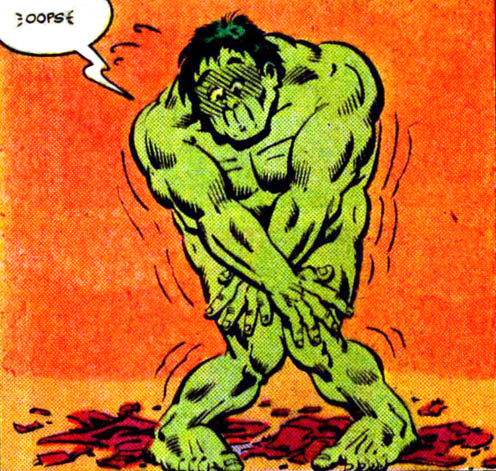
And why do Bruce Banner's pants never rip the same way the rest of his clothing does when he turns into the Hulk? I know, I know, they're just comic books.

Saturday, April 25, 2009

And of course a movie is being planned.


Scenes dealing with, or instruments associated with walking dead, torture, vampires and vampirism, ghouls, cannibalism, and werewolfism are prohibited.
Comics Code Authority, 1954
Recently my friend Laurie was complaining about being cursed by her own success at work. She's currently booking fitness training sessions at about twice her quota, and has been forced to request that her overtime limit be raised so that she can do all of her administrative tasks as well.

The impressive part is that she's not even trying to sell her services. As she commented, "It's like I can't escape these people, they seem to come out of nowhere!"

My reply was that I could easily imagine what it must be like: closing time at the gym, and she's just turned out the lights (as demanded by dramatic tradition in this area). Then, out of the shadows come the shambling, decaying figures of gym zombies, draped in tattered Lululemon outfits, with the moaning cry of "Traaaainnnnnn.....traaaaaainnn...."*

How is it that zombies have become part of the cultural landscape?

Zombies would seem to be a particularly 20th century conceit. The concept of the revenant, someone who has returned from the dead, exists as far back as the Middle Ages, but unlike the vampire or the werewolf, the current version of the zombie seems to owe very little to its historical antecedents.

EC Comics planted the seed for the modern zombie in its 1950's titles such as Vault of Horror and Tales from the Crypt, which featured the vengeful return from the grave by murder victims as a staple of its content. The whys and hows of such a return were secondary: the important part was the visual impact of these rotting horrors from the graveyard as they lurched into the homes of their killers to exact a grisly revenge.

Sadly, it was exactly this sort of over-the-top approach to storytelling which led to the downfall of EC Comics and their brethren. A psychiatrist named Fredric Wertham undertook a crusade against the adverse effects of EC's horrific tales and their negative impact on the children who read them, publishing his results in his infamous book The Seduction of the Innocent. In 1954, Congress undertook an investigation of juvenile delinquency, with Wertham as a prominent witness. The congressional committee concluded that comics were not directly responsible for delinquency among youth, but strongly recommended that some sort of control be instituted over the content of comics.

In response, the comics industry created the Comics Code Authority and its list of forbidden content. Since the list was more or less derived directly from the EC Comics material, EC soon found itself out of business.

However, EC left its mark by inserting the whole idea of zombies into the psyche of a generation of comic readers - and eventual movie makers. (The principals of EC also went on to develop MAD Magazine, which left a completely different mark, but I digress.)

The real front man for zombie promotion is of course George Romero, whose 1968 movie Night of the Living Dead might be considered the crop from the seeds planted by EC. In the years since Romero's black and white magnum opus, there have been innumerable zombie movies that have firmly established walking cannibal corpses as part of the horror canon. Interestingly, there's a common thread in these films that blames government experiments gone wrong for the rise of zombies, rather than any sort of supernatural process.

And now, the shelves of bookstores are graced by another attempt by zombies to earn acceptance in the mainstream: Seth Grahame-Smith's Pride and Prejudice and Zombies, which is actually credited to Jane Austen and Mr. Grahame-Smith. This dual credit strikes me as a marketing ploy - obviously the publishers are hoping that Ms. Austen will rise from the grave to avenge herself. (Perhaps some cameras should be set up near her gravesite in preparation.)

But really, when you think about it, Wertham and the Comics Code Authority people should have known better. After all, everyone knows that zombies eventually find a way in, no matter what.
- Sid

* Sadly, Laurie didn't get the "braaains" reference, but I thought it was funny.

Wednesday, April 8, 2009

"Wouldn't you rather see the whole movie?"


Imagine if you will: you and a couple of friends decide to head over to the Alamo Drafthouse Cinema, down there in Austin, Texas - they're going to show The Wrath of Khan, the best of the original series Star Trek movies, as part of this year's Fantastic Fest, and then there's supposed to be a ten minute preview from the new Star Trek prequel movie. There's a bit of chat from the guests from the production team of the new movie about the preview, then Wrath of Khan starts.

Ah, come on - two minutes in and the film jams? Damn analog technology.... Hold on, who's that on stage? Leonard Nimoy? Spock? What? And he's just asked if we wouldn't rather see the WHOLE new Star Trek movie?!

The surprise premiere of the new Star Trek movie at this year's Fantastic Fest in Austin, Texas, an annual film festival dedicated to fantasy, horror, action and science fiction, has to be the best thank-you to the fan community of all time. It's also an extraordinarily brave thing to do, especially considering that the recent Wolverine work print leak is still echoing around the Internet. But even without that, I have to give Paramount full credit for boldly combining a brilliant guerilla marketing move with an acknowledgement of the importance of the fans to the Star Trek franchise.

It's also going to make those people in the audience into legends in the fan community: "We few, we happy few, we band of brothers", as Shakespeare puts it. Of course, the hard core being what it is, you can guarantee that at least one person in the audience was angry about not seeing Wrath of Khan for the 215th time.
- Sid

Tuesday, March 24, 2009

Some things defy description.

"...to boldly go where no...man....has gone before."
Sky, Ninja Babes from Space

I make no judgements, I state no opinions: Ninja Babes from Space.
- Sid

Monday, March 23, 2009

Achievable Technology.

"But iron!"
"Hell, we're not savages, Devan, are we? When we came to this place we didn't revert back. We still have our minds. All we need is a blast furnace, some iron ore and a fire, isn't it?"
Jerry Sohl, Costigan's Needle
I've just finished re-reading my battered copy of Jerry Sohl's 1953 novel Costigan's Needle - I own the 1968 edition, so it's not as battered as it might be if I owned one of the original paperbacks.* I suspect I first read my mother's copy in my early teens, but I can't remember if I found the concept as unlikely then as I find it to be now.

For those of you unfamiliar with what Mr. Sohl considered to be his best novel**, the titular Dr. Costigan invents a device which creates an opening into another place, an opening which only allows the transmission of living matter. The device is damaged by angry Christian fundamentalists, and the resulting overload sends every living cell within a two-block radius into another world, sans clothing, shoes, glasses, fillings, pacemakers, and all of the other crutches for everyday life that technology has provided.

Naked and shivering, their first decision is to rebuild the device and return. Ten years later, they turn on the power to the new Needle and prepare to send everyone back through its Eye, only to discover that no one wants to leave.

Impressively, after ten years the inhabitants of Sohl's New Chicago have all the conveniences of life: steel for hammers, nails, and wire; glass for bottles, windows, glasses and light bulbs; plastics for dishes and insulation; tobacco and paper for cigarettes - and phosphorus for matches with which to light them. Their dentist fills teeth with gold and their doctors use ether as an anaesthetic, and their power plant provides the electricity for the new Needle.

I'm sorry, but I'm skeptical. Quick pop quiz: how many people reading this know how to make iron? We all know that glass is made out of sand - but how? It's got to be more complicated than just heating up some sand, or else there would be little glassy pits every time someone lit a fire on a beach. For that matter, if you were dropped naked into the woods, would you even be able to start a fire? How about building a cell phone and calling for help?

Now, I realize that Sohl has loaded the dice, in that the inventor of the Needle and a room full of scientists and technicians get transported, but even then I have to question the ability of 395 people to recreate enough of our civilization to be able to build log cabins that don't leak when it rains, let alone to the point of constructing complicated electronic devices. I strongly suspect that in reality all 395 of them would be involved in a constant struggle to get enough food on the table,with very little time left over to start figuring out the right impedance for a capacitor.

However, I must be the only person who feels this way. The something-from-nothing technological meme is fairly common in science fiction, with Mark Twain's A Connecticut Yankee in King Arthur's Court getting the ball rolling. All sorts of people seem to get transported or displaced into other dimensions or other times where their knowledge allows them to either revolutionize society or to build a new one from scratch, and a surprising percentage of these people know how to make gunpowder.

One of the more plausible amateur chemists is Calvin Morrison, the protagonist of H. Beam Piper's Lord Kalvan of Otherwhen. However, Calvin - or Kalvan - realizes immediately that he's not going to be able to convert the late-medieval society in which he finds himself into the equivalent of the industrial revolution in order to help them win a war. What he can do is to help them move about a hundred years further ahead: better gunpowder, rifled barrels, trunnions on cannon, and so on, which I find far more believable than having them build Sherman tanks.

Similarly, William R. Forstchen's "Lost Regiment" series presents one of the few "rebuild society from nothing" scenarios that worked for me. His characters are a shipload of Civil War soldiers whose ship gets swept out to sea and ends up going through a dimensional portal in the Bermuda Triangle. Forstchen loads his dice by having the ship loaded with a variety of useful military and engineering supplies, but even without that I'd accept the idea of a group of Civil War soldiers being able to start with almost nothing and recreate their society.

Why is that? I think that there's some kind of break point around the end of the 19th century after which the number of steps between phases of technology grows larger and larger. A miner in 1865 might well have known how to smelt down the ore, after he'd extracted it from the mine with pick and shovel. Or a blacksmith might have similar knowledge of what was involved with the ore before he began hammering the iron into nails. In current technology, the people who make the parts that are used to make the machines that make the parts for the machines that make the nails are unlikely to have ever seen the process of nailmaking, let alone have any idea of what iron looks like in its natural state.

The final joke for me is that if you sent 395 science fiction fans into another dimension, they might well do better than the average, just from having read so many variations on the theme. Oh, and the formula for gunpowder is 75% saltpeter, 15% sulphur and 10% charcoal. You might want to memorize that, just in case.
- Sid

*I have the impression that my sister Dorothy owns a copy as well, although I suspect hers may be in worse shape.

**Presumably everyone but Dorothy.